The Crowd Is Telling You Everything — You Just Don't Know the Language Yet
Every performer has heard some version of "read the room." It's one of those phrases that gets passed around like advice but rarely comes with actual instructions. Read the room — okay, great. But what exactly are you reading? What does a room that needs more energy actually look like? What does a crowd that's about to check out physically signal before they mentally leave?
The answers are there. They're just not in the applause.
The most useful information an audience gives you isn't the stuff they're consciously performing back at you. It's the involuntary stuff — the posture, the proximity, the breathing, the eye behavior. That's the real data. And once you know how to see it, performing becomes a completely different experience.
Why Surface-Level Reading Fails You
Most performers are trained, consciously or not, to monitor the obvious feedback loops: laughter, applause, silence, heckling. These are real signals, but they're lagging indicators. By the time a crowd goes quiet or starts checking phones, you've already lost several minutes of momentum you could have corrected earlier.
The physical signals come first. They're the leading indicators — the early warning system that tells you what the room is feeling before it decides how to express that feeling. Learning to catch those earlier signals gives you time to adjust proactively rather than reactively.
That's the difference between a performer who "saves" a rough show and one who never lets it get rough in the first place.
The Physical Tells Worth Watching
This is the practical part. These are real, observable behaviors that audiences display in real time. Build the habit of scanning for them.
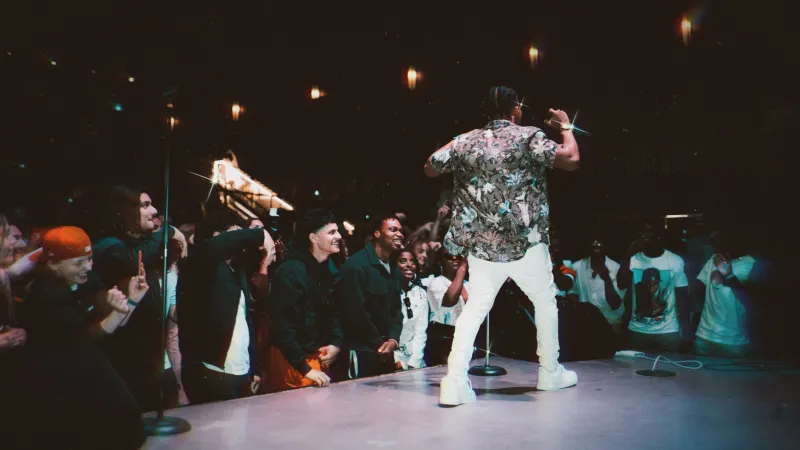
Postural lean. When a crowd is genuinely engaged, people lean forward — subtly, often unconsciously. You'll see shoulders come in, elbows move off armrests, chins tilt slightly upward. The inverse is equally clear: when energy drops, people settle back, cross their arms, or shift their weight toward the exit side of their seat. A room that's leaning in is a room that's with you. A room that's leaning back is a room that's deciding.
Spatial clustering. Pay attention to how the audience is distributed in the room, especially early in your set. A crowd that's spreading out — moving toward the walls, leaving gaps near the stage — is creating emotional distance. A crowd that's gravitating toward the center and toward you is consolidating its attention. If you watch carefully, you can often catch this shift in the first few minutes and use your opening material to pull people back in before the distance becomes a habit.
Eye contact patterns. Sustained eye contact from individual audience members is a strong positive signal — they're tracking you, they're invested. Scattered eye contact, where people are looking at each other rather than at you, can mean two things: either you've said something that's generating genuine shared reaction (good), or they're checking to see if other people feel as disconnected as they do (not good). Context tells you which. If the scattered eye contact comes with smiles and nudges, you're connecting. If it comes with flat expressions, you're losing them.
Breathing and noise floor. This one takes practice to notice, but it's powerful. A highly engaged audience gets quiet in a very specific way — not the quiet of boredom, but the held-breath quality of genuine anticipation. You can hear the difference. Contrast that with the low ambient noise of a restless crowd: the shuffle of feet, the cough clusters, the whispered side conversations. That ambient noise is a real-time readout of collective attention. When it rises, your grip on the room is loosening.
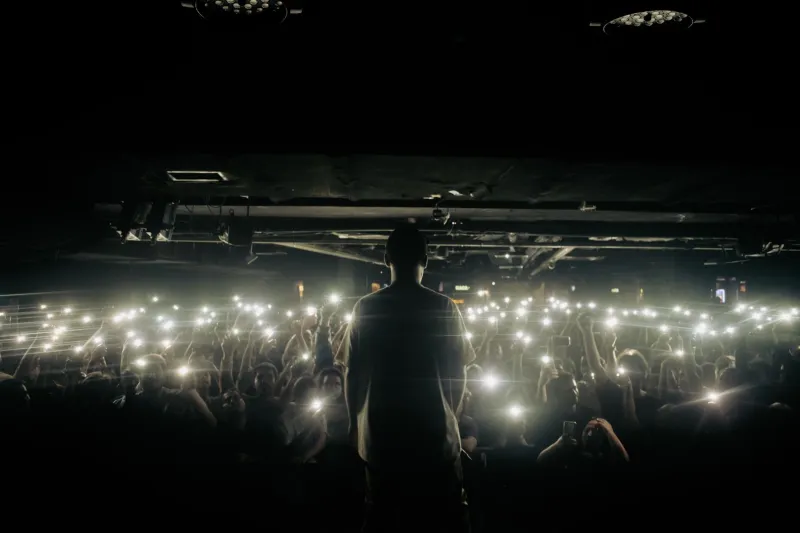
Phone behavior. Not just whether people are on their phones, but when. A phone that comes out during a transition or a slower moment is different from a phone that comes out mid-punchline. The former is a pacing note; the latter is a warning. Also watch for the opposite: a crowd that has stopped reaching for phones altogether, even during natural pause moments, is a crowd that doesn't want to miss anything. That's the feeling you're chasing.
Making Real-Time Adjustments That Don't Break the Show
Reading the room is only useful if it informs decisions you can actually execute in the moment. The key is building a small set of adjustable variables that you can deploy without disrupting the flow of your performance.
Pace is usually the first lever. If the room is restless, speeding up slightly — tightening transitions, cutting breath time between beats — can re-engage attention without the audience ever knowing you made a choice. If the room is overwhelmed or overstimulated, pulling back and giving them a moment to breathe can reset the connection.
Physical proximity is another. Moving toward a section of the audience that's drifting creates a gravitational pull. It's harder to disengage from a performer who's physically close to you.
Direct acknowledgment — a glance, a gesture, a comment aimed at a specific part of the room — can re-engage clusters that are starting to drift. Used sparingly, it feels spontaneous. Used skillfully, it's a precision tool.
The Goal Isn't Control — It's Conversation
Here's the mindset shift that makes all of this click: you're not trying to control an audience. You're trying to have a conversation with a room full of people who are communicating through their bodies rather than their words.
When you start seeing performance that way — as a two-way exchange where you're constantly receiving information and adjusting — the whole experience changes. You stop being surprised. You stop playing to an imagined crowd and start performing for the actual one in front of you.
That's when shows stop being good and start being the kind that people can't quite explain afterward. They just know they didn't want it to end.
And that's the whole point.