Big Stage, Small Stage, Same You: How to Own Every Room Without Losing What Makes You Special

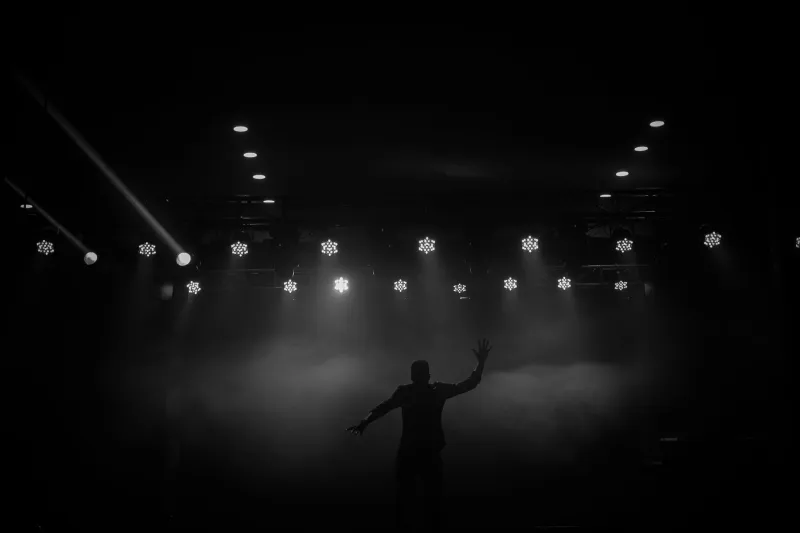
Photo by Photo by Liam McGarry on Unsplash on Unsplash
There's a moment every performer knows. You walk out onto a stage that's either way bigger or way smaller than what you rehearsed for, and your body does this weird freeze thing. Your instincts tell you to either shrink or overcorrect. Neither works. And the audience — whether it's 40 people sipping craft beer in a Chicago basement bar or 2,000 folks in a seated theater in Nashville — they feel it immediately when you haven't figured out the room.
This is one of the most undertalked challenges in the entertainment world. Everyone wants to talk about writing better material, building your social following, or getting the right booking agent. But the actual craft of adapting to different venue sizes? That's where careers quietly get made or quietly fall apart.
Let's break it down.
The Intimate Room: Your Superpower and Your Trap
Small venues — your 75-seat comedy clubs, your listening rooms, your private event spaces — are incredible training grounds. The audience is close. You can see their faces. You can read a smirk, catch a raised eyebrow, and respond in real time. It's a conversation as much as it is a performance.
But here's the trap: a lot of performers get too comfortable in intimate spaces and start relying on that closeness as a crutch. They whisper when they should project. They lean into side conversations with front-row guests. They let the room's natural energy do half the work. That's fine — until you walk into a 500-seat theater and suddenly nobody in the back can feel you.
The fix isn't to abandon what works in small rooms. It's to understand why it works. Intimacy creates connection. Your job when you scale up is to manufacture that same sense of connection at a distance — and that takes intentional technique, not just volume.
Scaling Up: Energy, Projection, and the Space Between Notes
When you move into a larger venue, the first instinct is to get louder. Louder voice, bigger gestures, more movement. And yeah, some of that is necessary. But raw loudness isn't the same as presence.
Here's what actually changes when you scale up:
Physicality gets amplified. In a small room, a slight head tilt reads as playful. In a 1,000-seat venue, that same movement gets lost unless you lean into it. Your gestures need to travel. Think of it like the difference between texting someone versus speaking to a room — the same message needs different delivery.
Pacing slows down. This surprises a lot of performers. In big rooms, sound travels differently. There's reverb, delay, ambient noise from the back rows. If you rush your material the way you might in an intimate club, you're going to lose people. Silence becomes your friend. Pauses land harder. Give the room time to breathe.
Your relationship with the audience shifts. In a theater, you're not having a conversation — you're leading a shared experience. That's a different energy. You're not responding to one person in the third row; you're guiding the whole room together. Think about how performers like Dave Chappelle or Adele work massive venues. They still feel personal, but they're conducting the crowd, not just chatting with it.
Scaling Down: The Danger of Bringing Too Much Heat
Going the other direction — from a big stage to a small one — has its own landmines. Performers who've been working large venues sometimes show up to intimate spaces and blast the room with energy that's just too much. It's like turning on stadium lights in someone's living room. Uncomfortable.
In small rooms, subtlety is currency. A well-timed pause, a quiet aside, a moment of genuine vulnerability — these hit harder in close quarters than any big theatrical moment. If you've been touring arenas and you walk into a 100-seat listening room, you have to consciously dial it back. Not your passion, not your commitment — just the scale of your delivery.
One real-world example: a lot of touring musicians who play theaters bomb at house concerts because they can't turn off the performance mode. They hit every note perfectly but feel weirdly distant to a room of 30 people sitting ten feet away. Meanwhile, the singer-songwriter who's been playing coffee shops for three years walks in and kills it because they know how to let people in.
The Non-Negotiable: Protecting Your Core
Here's the thing that ties all of this together. Whether you're at a dive bar in Austin or a concert hall in New York, the essence of what you do has to stay intact. Your point of view. Your humor, your sound, your story. The thing that makes audiences walk away saying, "That person is unlike anyone else I've seen."
Room size should change your delivery, never your identity.
The performers who struggle with venue shifts are usually the ones who treat every new room like a completely different show. They lose themselves trying to fit the space. The ones who thrive treat the room as a variable they're solving for, while their core material and personality stay locked in.
Before any show — big or small — ask yourself: What's the one thing I need this audience to feel tonight? That anchor point keeps you grounded no matter how the room changes around you.
Practical Prep Before You Hit the Stage
A few things worth doing before you walk out:
- Walk the space empty. Seriously. Stand at the back of the room. Stand at the sides. Understand what the audience is experiencing before you perform for them.
- Sound check isn't just for sound. Use it to calibrate your physical energy. How far do your gestures need to travel? How much space do you have to move?
- Talk to the venue staff. They've seen hundreds of performers in that room. They know what works and what doesn't. That's free intel.
- Watch how the crowd fills in. A sold-out small room feels different from a half-full large one. Adjust accordingly.
The Showstoppr Takeaway
Every room is a new puzzle. The performers who figure it out fastest are the ones who've done the work to understand their own craft deeply enough that they can flex without breaking. You can be massive on a massive stage and magnetic in a 60-seat room — but only if you know what you're actually doing and why it works.
The goal is never to be a different performer for every venue. The goal is to be undeniably, unmistakably you — just calibrated for the room in front of you.
That's what a showstopper does.